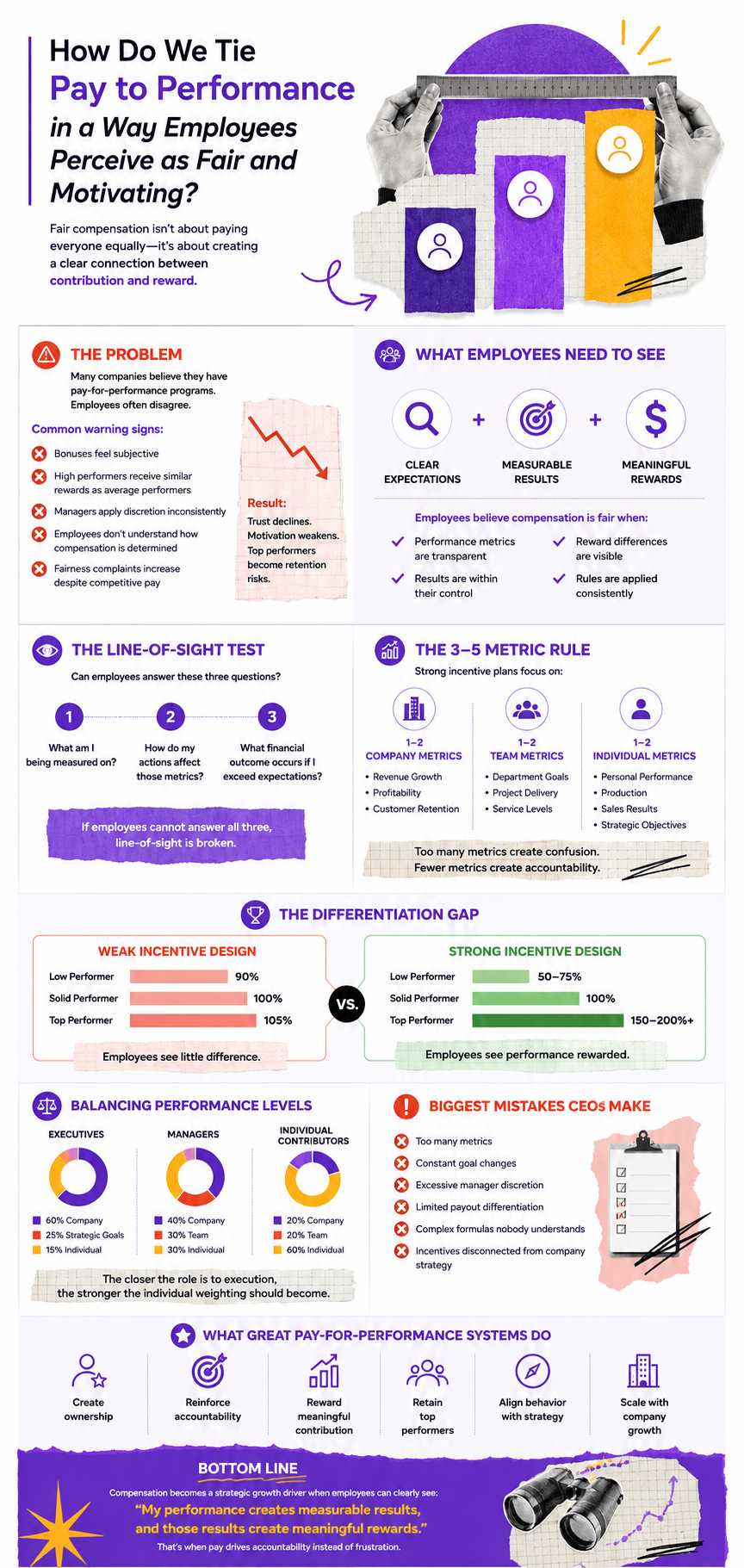

You tie pay to performance in a way employees perceive as fair and motivating by clearly defining what performance means, creating measurable line-of-sight to results, and ensuring meaningful differentiation in rewards.
In growth-stage companies, CEOs often believe they have a pay-for-performance system because bonuses exist, yet employees still describe compensation as “subjective” or “political.” High performers feel under-recognized, while average performers receive similar payouts. The result is quiet frustration rather than visible disengagement.
This problem typically emerges when incentive plans evolve informally as the company scales. Metrics become layered, goals shift mid-year, and managers apply discretion inconsistently. Employees then struggle to see how daily effort translates into financial reward.
Across VisionLink’s compensation strategy work with mid-market leadership teams, fairness concerns almost always trace back to unclear performance definitions or weak differentiation in payout design—not to compensation levels themselves.
- What leaders observe: Employees question fairness despite competitive pay.
- The structural issue: Performance metrics lack clarity, consistency, or line-of-sight.
- The strategic shift: Redesign incentive architecture so results employees influence directly determine outcomes.
Why Incentive Design Shapes Employee Perception of Fairness
Employees perceive pay as fair when they understand how performance is measured, believe the metrics are within their influence, and see clear differentiation between levels of contribution.
Perceived fairness is less about equal pay and more about transparent cause-and-effect. Incentive architecture is the system that connects employee actions, performance metrics, and financial rewards. When that architecture is unclear, trust erodes.
- Metrics are too broad or too numerous.
- Managers override formulas without clear guidelines.
- Company results dominate payouts even when individual impact varies.
- Top and average performers receive similar awards.
Compensation systems reinforce behavior whether intentionally designed or not. When employees cannot see how effort changes outcomes, motivation declines because the system feels arbitrary rather than performance-driven.
How Do You Create Clear Line-of-Sight Between Actions and Rewards?
Clear line-of-sight exists when employees can directly connect their daily decisions to measurable performance metrics that determine their pay.
Line-of-sight requires narrowing the focus. Many mid-market companies overload incentive plans with company-wide KPIs that individual contributors cannot influence. As a result, strong individual performance feels disconnected from financial recognition.
- Limit incentive metrics to 3–5 critical drivers.
- Match metrics to role-specific impact.
- Clarify thresholds, targets, and maximums in advance.
- Communicate how each metric supports company strategy.
This is exactly the type of compensation misalignment VisionLink helps companies diagnose and correct through structured incentive plan redesign. Resources such as Will Your Bonus Plan Fail Again Next Year? outline common design flaws that weaken line-of-sight.
How Much Differentiation Is Necessary for Pay to Feel Performance-Based?
Pay feels performance-based when meaningful financial differences exist between low, solid, and exceptional performance.
Many organizations unintentionally compress payouts. If most employees receive between 90% and 105% of target bonus, the incentive plan communicates stability—not performance differentiation.
- Low performance should visibly reduce payout.
- Solid performance should earn target.
- Exceptional performance should produce significant upside.
High-performing compensation systems align three elements: clear metrics, meaningful upside, and visible differentiation. When upside is capped too tightly or downside is protected too generously, motivation shifts toward maintaining status rather than creating value.
Many CEOs address this by working with VisionLink advisors to redesign their incentive architecture so compensation becomes a growth driver rather than a cost center, as outlined in Principles that Should Guide Compensation Design.
How Should We Balance Individual, Team, and Company Performance?
The right balance aligns each employee’s sphere of influence with company outcomes while reinforcing shared accountability.
Overweighting company metrics can dilute individual accountability. Overweighting individual metrics can undermine collaboration. The solution is layered design.
- Company metrics reinforce shared success and ownership mentality.
- Team metrics drive cross-functional collaboration.
- Individual metrics reward personal contribution.
In working with scaling companies, VisionLink often finds that executives benefit from a mix of company and strategic metrics, while frontline roles require stronger individual performance weighting. This layered approach reinforces both ownership and accountability.
For CEOs exploring how compensation connects to measurable outcomes, How to Effectively Link Compensation to Results provides a structured framework for aligning incentives with ROI.
What We See in Practice
- Across VisionLink engagements, many companies introduce bonus plans before defining clear performance standards.
- Fairness complaints often decline when performance scorecards become simpler and more transparent.
- Incentive gaming typically emerges when metrics are misaligned with operational reality.
- The fastest cultural shifts occur when employees can articulate exactly how their work drives company value.
- Leadership teams frequently underestimate how strongly payout differentiation shapes performance culture.
Companies that want this level of alignment typically engage VisionLink to design compensation frameworks that reinforce ownership mentality and sustained growth.
Frequently Asked Questions
Should incentive plans rely more on objective metrics or manager discretion?
Incentive plans should rely primarily on objective metrics with limited, structured discretion.
Objective metrics build trust and predictability, while clearly defined discretion allows leaders to address unique circumstances without undermining perceived fairness.
Can small bonus opportunities still motivate employees?
Small bonus opportunities rarely drive meaningful behavior change.
Incentives must be large enough to matter financially and psychologically; otherwise, they function more as symbolic recognition than performance drivers.
How do we communicate pay-for-performance without creating entitlement?
Clear performance standards and transparent payout formulas reduce entitlement.
When employees understand that rewards follow measurable results—not tenure or negotiation—expectations shift from entitlement to earned opportunity.
What is the biggest mistake CEOs make when tying pay to performance?
The biggest mistake is adding complexity instead of clarifying performance expectations.
Overly complex incentive plans reduce transparency, weaken line-of-sight, and ultimately undermine the motivational intent of pay-for-performance systems.
When pay clearly reflects measurable contribution, employees do not just feel compensated—they feel accountable. And accountability, reinforced through thoughtful incentive design, is what transforms compensation from an expense into a strategic growth investment.